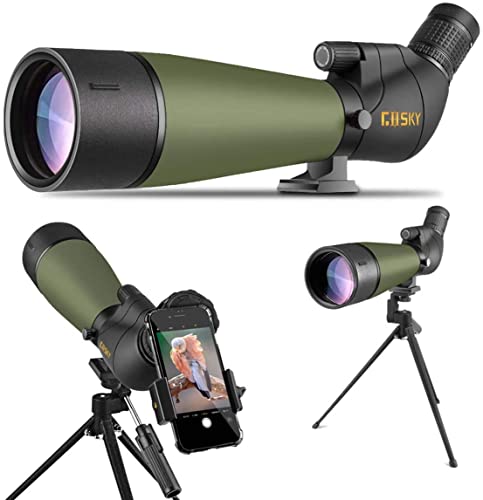
Buying Guide for the Best Bird Watching Scopes
Choosing the right bird-watching scope can greatly enhance your bird-watching experience by providing clear and detailed views of birds from a distance. When selecting a scope, it's important to consider several key specifications to ensure you get the best fit for your needs. Understanding these specs will help you make an informed decision and enjoy your bird-watching adventures to the fullest.MagnificationMagnification refers to how much closer the scope can make distant objects appear. This is important because higher magnification allows you to see more details of the birds. Scopes typically offer magnification ranges like 20-60x. Lower magnification (20-30x) provides a wider field of view and is easier to use for tracking moving birds. Higher magnification (40-60x) offers more detail but can be harder to stabilize and may require a tripod. Choose a magnification range based on your bird-watching habits; if you often watch birds in open areas, higher magnification might be beneficial, while lower magnification is better for forested areas.
Objective Lens DiameterThe objective lens diameter is the size of the front lens of the scope, measured in millimeters. This spec is crucial because a larger diameter allows more light to enter the scope, resulting in brighter and clearer images, especially in low-light conditions. Common sizes range from 50mm to 80mm. Smaller diameters (50-60mm) make the scope lighter and more portable, ideal for long hikes. Larger diameters (70-80mm) provide better image quality but are bulkier. Consider where and when you will be using the scope; if you often bird-watch at dawn or dusk, a larger objective lens is advantageous.
Field of ViewField of view (FOV) is the width of the area visible through the scope at a specific distance, usually measured in feet at 1000 yards. A wider FOV makes it easier to locate and follow birds, especially those in flight. Scopes with a wider FOV are generally more user-friendly for beginners. If you are new to bird-watching or often observe fast-moving birds, opt for a scope with a wider FOV. Experienced bird-watchers who focus on stationary birds might prefer a narrower FOV for more detailed observation.
Eye ReliefEye relief is the distance from the eyepiece to your eye where you can still see the full field of view. This is particularly important for eyeglass wearers, as insufficient eye relief can make it difficult to see the entire image. Eye relief typically ranges from 12mm to 20mm. If you wear glasses, look for a scope with at least 15mm of eye relief to ensure comfortable viewing. Non-eyeglass wearers can manage with shorter eye relief, but longer eye relief can still enhance comfort during extended use.
Lens CoatingLens coating refers to the special coatings applied to the lenses to reduce glare and improve light transmission, resulting in clearer and brighter images. There are different levels of coating: coated, fully coated, multi-coated, and fully multi-coated. Fully multi-coated lenses offer the best performance by maximizing light transmission and minimizing reflections. If you plan to use your scope in various lighting conditions, investing in a scope with fully multi-coated lenses will provide the best image quality. For casual use in good lighting, lower levels of coating may suffice.
Weight and PortabilityWeight and portability are important factors, especially if you plan to carry your scope over long distances. Heavier scopes can provide better stability and image quality but can be cumbersome to transport. Lighter scopes are easier to carry but may compromise on some features. Consider how you will be using the scope; if you often hike to your bird-watching spots, a lighter, more portable scope is preferable. If you primarily bird-watch from a stationary location, a heavier scope with better stability might be more suitable.
Durability and Weather ResistanceDurability and weather resistance are crucial for outdoor use. Look for scopes that are waterproof and fog-proof to ensure they can withstand various weather conditions. Scopes with rubber armor provide additional protection against bumps and drops. If you frequently bird-watch in harsh environments or unpredictable weather, prioritize a scope with high durability and weather resistance. For more controlled environments, these features may be less critical but still beneficial for long-term use.